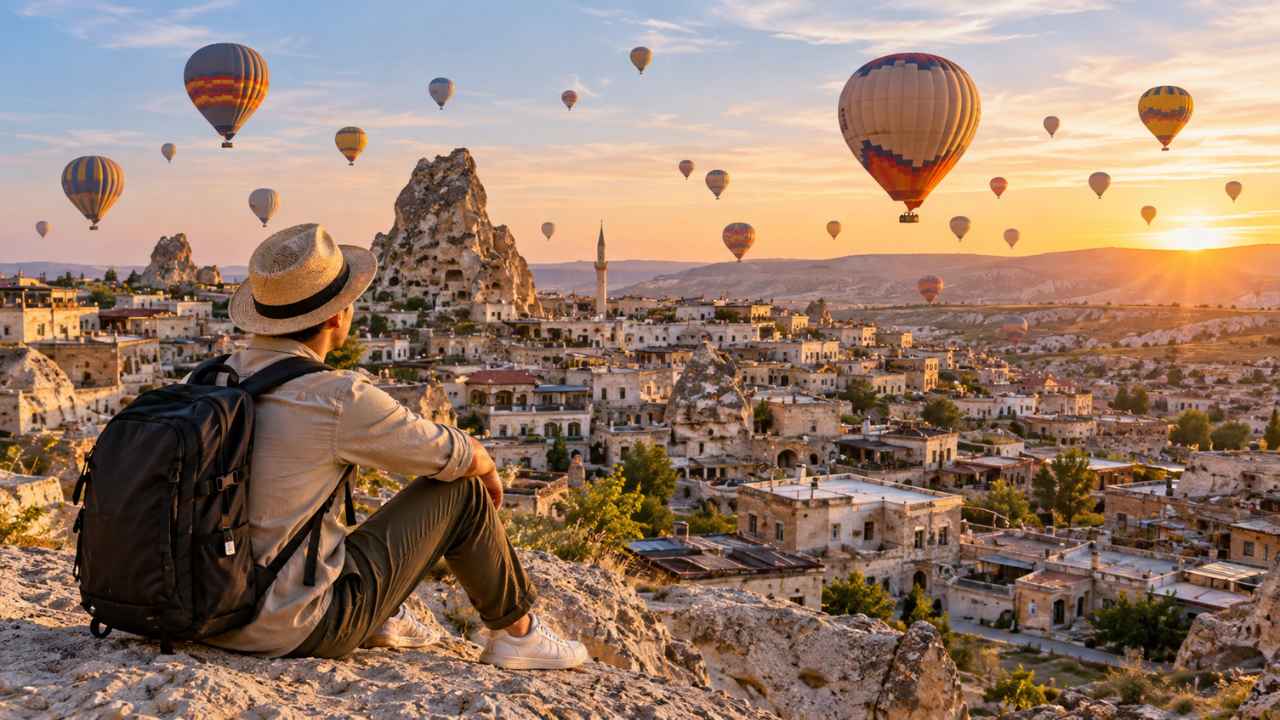
Turkey stretches across two continents—Asia and Europe—and is one of the world’s most compelling travel destinations. In a single trip, travelers can move from the dome of Hagia Sophia in Istanbul to the balloons rising over Cappadocia at sunrise, walk the white terraces of Pamukkale, wander the ancient city of Ephesus, and relax on the Mediterranean coast of Antalya.
This page is the parent hub for all destination guides, articles and travel tips across Turkey: from its standout cities and sites, food and traditional bazaars, to the best time to visit, transport, sample itineraries, and the local tips and etiquette worth knowing before you go.
Turkey at a Glance
| Category | Details |
|---|---|
| Capital | Ankara |
| Largest city | Istanbul |
| Continents | Asia (Anatolia) and Europe (Thrace) |
| Language | Turkish |
| Currency | Turkish lira (TRY, ₺) |
| Time zone | UTC+3 (year-round) |
| Population | Around 85 million |
| Religion | Majority Muslim; a secular state |
| Main airports | Istanbul (IST), Sabiha Gökçen (SAW), Antalya (AYT), Izmir (ADB) |
| Travel icons | Hagia Sophia, Cappadocia, Pamukkale, Ephesus, Grand Bazaar |
| Best time | Spring (April–May) and autumn (September–October) |
Getting to Know Turkey: A Country of Two Continents
Turkey sits at the crossroads of Europe and Asia. The Thrace region in the northwest lies in Europe, while the far larger Anatolia lies in Asia. The two are separated by the Bosphorus and the Dardanelles, the straits that also link the Black Sea with the Aegean and the Mediterranean.
That position makes Turkey a cultural bridge: the heritage of Byzantium, the Ottoman Empire, and the modern republic all meet in one country.
Regions Worth Knowing
- Marmara & Istanbul — the historic, cultural and economic heart; the main gateway for travelers.
- Cappadocia (Central Anatolia) — volcanic rock landscapes, underground cities and hot-air balloons.
- Aegean — Ephesus, Izmir, Pamukkale and coastlines that have mattered since antiquity.
- Mediterranean — Antalya, Fethiye and the string of destinations along the Turkish Riviera.
- Eastern Anatolia & the Black Sea — mountains, highlands and cities such as Trabzon.
A Little History
Modern Turkey was founded in 1923 from the ruins of the Ottoman Empire after World War I, led by Mustafa Kemal Atatürk, who turned the country into a secular republic. Long before that, the region was home to the Hittite, Greek, Roman and Byzantine civilizations—a legacy still visible in ancient sites across the country.
The Best Places to Visit in Turkey
1. Istanbul
Istanbul is one of the only major cities in the world spread across two continents, divided by the Bosphorus. The historic Sultanahmet district is the best place to get to know the city. The landmarks you should not miss include:
- Hagia Sophia — an architectural masterpiece that has served as a basilica, mosque and museum, and is a mosque again today.
- The Blue Mosque (Sultan Ahmed Mosque) — famous for its domes and blue tiles.
- Topkapi Palace — the palace of the Ottoman sultans, now a museum.
- The Basilica Cistern — an atmospheric underground chamber lined with columns.
- The Grand Bazaar and Spice Bazaar — historic markets for shopping and soaking up the city’s atmosphere.
Beyond the monuments, you can take a boat along the Bosphorus to see Istanbul from both sides, or catch the sunset around Galata and the Galata Tower.
2. Cappadocia and the Hot-Air Balloons
Cappadocia is famous for its unusual volcanic rock formations, fairy chimneys, underground cities, rock-cut churches and cave hotels.
Its best-known experience is a hot-air balloon ride at sunrise. From the air, travelers see valleys, rock formations and the settlements of Cappadocia spread out below. Popular areas include Göreme, Uçhisar, Love Valley, Paşabağ, Avanos and Derinkuyu. Because flights depend on the weather, allow more than one day if the balloon ride is a priority.
3. Pamukkale and Its Travertine Pools
Pamukkale has a striking white landscape formed by mineral deposits from natural hot springs. Its tiered travertine terraces make the area look like a field of snow from a distance.
Nearby lies Hierapolis, an ancient Roman city with a theater, necropolis and thermal springs. The combination of natural scenery and archaeology makes Pamukkale one of the most popular stops on any tour of Turkey.
4. Ephesus and the Traces of Ancient Civilizations
History lovers should put Ephesus on their itinerary. This ancient city was once a major center in Greek and Roman times, with paved streets, temples, an agora and a great theater that still stands.
Its best-known structure is the Library of Celsus, whose grand facade is the icon of the site. Nearby you’ll find the House of the Virgin Mary and the Basilica of St. John, making the town of Selçuk a convenient base for exploring Ephesus.
5. Antalya and Mediterranean Charm
Antalya on the Mediterranean combines an old town, beaches, resorts, mountains and history. Kaleiçi, the historic quarter of narrow lanes, traditional houses, boutique hotels and an old harbor, is a rewarding place to wander on foot.
Antalya is also a starting point for the Turkish Riviera, including Düden Waterfalls, the ancient cities of Side and Aspendos, and the rocky beaches around Kemer and Kaş.
Other Stops Worth Adding
- Bursa — the first Ottoman capital, with historic mosques and a silk market.
- Izmir & Çeşme — relaxed Aegean coastal towns with great seafood.
- Konya — a spiritual center with Sufi heritage and the Whirling Dervishes.
- Ankara — the capital, with museums and Atatürk’s mausoleum (Anıtkabir).
- Fethiye & Ölüdeniz — sandy bays and paragliding.
- Nemrut Dağı — a mountaintop with giant statues left by the kingdom of Commagene.
- Gallipoli — the World War I battlefields along the Dardanelles.
Enjoying Turkish Food
No trip to Turkey is complete without its food. Turkish cuisine grew out of Anatolian, Mediterranean and Middle Eastern traditions and the Ottoman legacy—a mix that yields rich, varied flavors.
Dishes and Snacks to Try
- Kebab and döner — grilled meat in many forms.
- Pide and lahmacun — flatbreads with toppings, often called “Turkish pizza”.
- Menemen — scrambled eggs with tomato, peppers and spices.
- Meze — small starter dishes to share.
- Mantı — tiny dumplings served with yogurt.
- Gözleme — thin flatbread filled with cheese, vegetables or meat.
- Simit — a sesame-crusted ring bread, a favorite street snack.
- Baklava, künefe and Turkish delight (lokum) — legendary sweets.
- Turkish coffee and Turkish tea (çay) — drinks woven into daily culture.
Halal, Vegetarian and Special Needs
Because most of the population is Muslim, finding halal food in Turkey is relatively easy, especially outside tourist areas. For vegetarians, there are plenty of vegetable, meze and cheese dishes; just check whether broths or fillings contain meat. Many restaurants in tourist areas also offer English menus.
Shopping in Traditional Bazaars
Traditional bazaars are a highlight of any visit to Turkey. Istanbul’s Grand Bazaar is one of the most famous historic covered markets, with thousands of shops and winding corridors.
Travelers can find carpets, ceramics, decorative lamps, textiles, jewelry, spices, tea, coffee and all kinds of Turkish souvenirs. A few tips:
- Haggle politely in traditional bazaars; it’s part of local culture.
- Compare prices at a few shops before you decide.
- Keep receipts and check authenticity, especially for higher-value items.
Shopping in the bazaars is also a chance to feel a trading culture that has been part of city life for centuries.
The Best Time to Visit Turkey
Turkey can be visited year-round, but the experience changes with the seasons.
- Spring (April–May) — comfortable temperatures and green, blooming landscapes; a favorite for cities and nature.
- Summer (June–August) — long days, ideal for beaches and the Turkish Riviera, though some destinations are hot and crowded.
- Autumn (September–October) — relatively comfortable temperatures for city and history trips, with smaller crowds.
- Winter (December–February) — a different mood, especially in snowy areas such as Cappadocia and the mountains of Eastern Anatolia; some coastal destinations are quieter.
For city and history trips, spring and autumn usually offer the best balance of weather, crowds and prices. Match your dates to the regions you want to see and the activities you have planned.
Getting Around Turkey
Turkey has a transport network that connects its cities and tourist destinations.
- Domestic flights — the fastest option for long distances, e.g. Istanbul–Cappadocia (Kayseri/Nevşehir) or Istanbul–Antalya.
- High-speed trains (YHT) — comfortably link Istanbul, Ankara, Konya and a few other cities.
- Intercity buses — an extensive network with large terminals (otogar); often a budget-friendly choice on certain routes.
- City transport — Istanbul has metro, tram, bus and ferry, with the Istanbulkart usable across several modes.
For cross-region travel, grouping destinations by geography keeps your trip efficient and avoids losing days on the road.
Sample Turkey Itineraries
For a first trip, several key destinations can be combined into one itinerary.
Days 1–3 — Istanbul Explore Sultanahmet (Hagia Sophia, Blue Mosque, Topkapi Palace), the Basilica Cistern and the Grand Bazaar, then cruise the Bosphorus.
Days 4–5 — Cappadocia Fly to Cappadocia for its fairy chimneys, underground cities and a sunrise hot-air balloon flight.
Day 6 — Pamukkale Head to Pamukkale for the travertine terraces and the ancient city of Hierapolis.
Day 7 — Ephesus Discover the ancient city of Ephesus near Selçuk.
Days 8–10 — Antalya or Istanbul Relax on the Mediterranean coast at Antalya, or return to Istanbul for anything you missed.
Length and order can be adjusted to your flight schedule, the season, your budget and the destinations you prioritize.
Tips, Etiquette and Safety in Turkey
- Check your passport and visa for your nationality; rules can change, so verify with official sources before you travel.
- Check the weather forecast—conditions differ noticeably between Istanbul, Cappadocia, the coast and the mountains.
- Wear comfortable clothing and shoes; many historic sites involve a fair amount of walking.
- Respect the rules at places of worship — cover your shoulders and knees, and follow local guidance during prayer or in specific areas.
- Book transport and accommodation early, especially in peak season.
- Carry some cash; major cities generally accept cards, but small shops are easier with cash.
- Save emergency numbers and your embassy’s contact, and buy travel insurance.
Turkey Travel FAQ
How long do I need for a trip to Turkey?
For a first trip covering Istanbul, Cappadocia and one or two Aegean/Mediterranean destinations, 8–10 days is usually enough. If you prefer a slower pace, 10–14 days gives you room to change cities without rushing.
Do I need a visa for Turkey?
Visa rules depend on your nationality and can change. Some travelers can apply for an e-Visa under certain conditions, while others must apply through a Turkish mission. Always check the latest information on official channels before booking.
When is the best time to visit Turkey?
In general, spring (April–May) and autumn (September–October) are the most comfortable for city and history trips. Summer suits the beaches but is busy; winter offers snow.
Can I visit Cappadocia without the balloons?
Yes. Balloon flights depend on the weather and can be cancelled, but Cappadocia is still rewarding to explore through its valleys, underground cities, rock churches and cave hotels.
What is the average daily cost in Turkey?
Costs vary widely. A budget trip (hostels, street food, public transport) can be far cheaper than comfortable accommodation in prime tourist areas. Plan according to your travel style.
Start Here
This hub will keep growing with guides to destinations across Turkey. Until the next article is published, start here:
- West Asia hub — the regional guide that hosts Turkey.
- Asia hub — the continent’s parent hub for cross-region travel.
- Travel Essentials — practical tips, from power plugs to cross-border payments.
Turkey blends thousands of years of history with modern life. Pick a route that fits your time and travel style, match it to the best season, and build the trip step by step—rather than waiting for everything to be perfect in a single holiday.