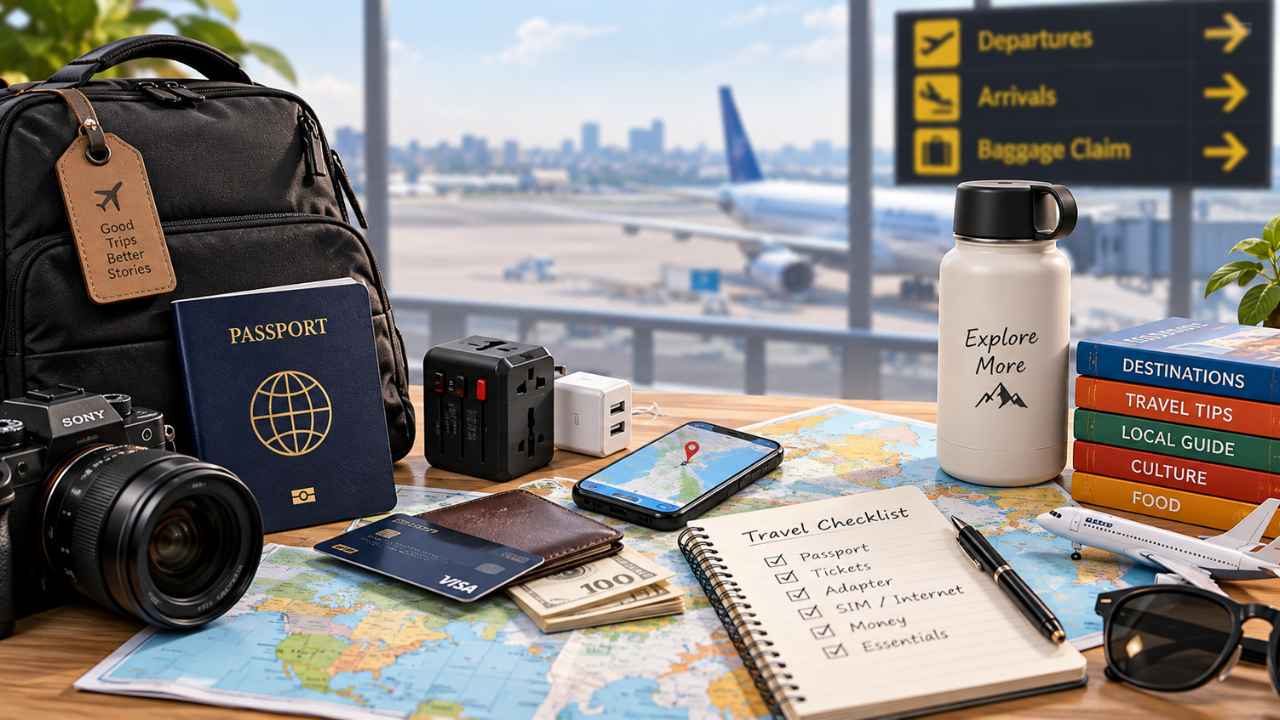
Travel Essentials is the category of practical guides about the small things that decide how smoothly a trip goes: plugs and travel adapters, mains voltage, internet access and SIM/eSIM cards, currency and payment methods, travel documents, baggage rules, and the gear you should always keep in your suitcase.
Many travel problems don’t come from the destination; they come from something considered trivial: a charger that doesn’t fit the sockets at your destination, a phone that can’t get online the moment you land, a debit card declined at the till, or a passport with only five months left on it. All of these can be avoided with a few minutes of preparation before you leave.
This page is the parent hub for every Travel Essentials guide on Travelawan. It is written for independent travellers: it uses common plug types and voltage as the starting point, treats currency and payment methods as the baseline for planning spend, and highlights the documents and baggage rules that most often cause trouble at the airport.
What Travel Essentials Covers
| Category | What It Covers | Why It Matters |
|---|---|---|
| Plugs & travel adapters | Socket types A–O, the plugs used in Indonesia, how to choose an adapter | A device cannot be charged at all without a matching socket |
| Voltage & frequency | 110–120 V vs 220–240 V, dual voltage, converters | The wrong voltage can destroy a charger, an iron, or a hair dryer |
| Internet & SIM cards | Local SIM, eSIM, roaming, pocket WiFi, public Wi-Fi | Maps, ride-hailing, and digital payments all depend on data |
| Currency & payments | Cash vs cards, ATMs, transaction fees, cross-border QR | A backup payment method stops you getting stuck at the till |
| Travel documents | Passport, visa, tickets, insurance, international driving permit | Incomplete documents can get you turned away at the border |
| Baggage & gear | Cabin limits, power bank and lithium battery rules, liquids, medicine | Packing dangerous items in the wrong bag can end in confiscation |
| Transport at the destination | Airport trains, metro, taxis, apps, transit cards | Getting from the airport to your accommodation is often the first hurdle |
1. Plugs and Travel Adapters
Socket shapes differ from country to country. There are around 15 socket types in use worldwide, from Type A to Type O, and some countries use more than one—for example China (A, C, I) or Thailand (A, B, C).
Plugs from Indonesia are generally Type C (two round pins). That means:
- In Europe, Vietnam, Turkey, and most countries using Type C, E, or F sockets, your charger can often be plugged in directly.
- In Japan, the United States, Taiwan, Singapore, Malaysia, Hong Kong, and Australia, a Type C plug needs an adapter because the socket shapes differ (A/B, G, or I).
- In China, sockets are generally Type I and A, but many hotels use combination sockets that also accept Type C—still, bringing an adapter is safer.
- Devices with a narrow body or a three-pin plug (Type G) still need a specific adapter for the destination.
The socket types travellers meet most often:
| Socket Type | Pin Shape | Example Countries/Regions |
|---|---|---|
| A / B | Two or three flat pins | United States, Canada, Japan, Taiwan, Mexico |
| C / E / F | Two round pins | Almost all of Europe, Vietnam, Turkey, South Korea (C/F) |
| G | Three rectangular pins (UK) | United Kingdom, Singapore, Malaysia, Hong Kong, United Arab Emirates |
| I | Two angled/vertical flat pins | Australia, New Zealand, China (with types A and C), Argentina |
| D / M | Three large round pins | India (D), South Africa (M), parts of Africa |
| L | Three pins in a row | Italy |
| N | Three round pins | Brazil, South Africa (in part) |
Tips for choosing an adapter:
- Choose a universal travel adapter if you are visiting several countries in one trip; some models also provide USB ports, so a single tool can serve several devices.
- Bring a small power strip (extension cord) if you have many devices. Many hotel rooms provide only one or two sockets.
- Favour adapters with a locking mechanism and good build quality. Cheap adapters often sit loose, so the charger falls out or sparks.
- An adapter is not a converter. An adapter only changes the pin shape, not the voltage. See the next section.
2. Voltage and Mains Frequency
Besides the plug shape, pay attention to the voltage at your destination.
- Many countries in the Americas and Japan use around 110–120 V, while Indonesia, Europe, China, Australia, and most of Asia use around 220–240 V.
- Frequency can differ too: Indonesia uses 50 Hz, while some countries use 60 Hz. This rarely affects chargers, but it can affect motorised appliances or timers.
- Modern devices such as phone chargers, laptops, and power banks usually state
Input: 100–240 V, 50/60 Hz. These are safe to use in any country and only need a plug-shape adapter. - High-power appliances—hair dryers, hair straighteners, irons, electric kettles—are often designed for a single voltage (for example only
220–240 V). Plugging them into 110 V makes them run weakly, while plugging a 110 V appliance into 240 V can destroy it instantly. - If your appliance is not dual voltage and must be used, you need a voltage converter rated for a higher wattage than the appliance. For a short trip it is usually easier to borrow one from the hotel or use the accommodation’s low-power dryer.
Quick check: read the label on the adapter/charger or the body of the appliance, then match the V and Hz figures to your destination.
3. Internet and SIM Cards
Internet access is now part of the basic travel kit: maps, ride-hailing, ticket booking, payments, translation, and even emergencies all depend on a data connection. The options available:
| Option | Advantages | Drawbacks | Best For |
|---|---|---|---|
| International eSIM | Activated before you leave, no need to swap cards, works the moment you land | Needs an eSIM-capable phone; data allowance is usually limited | Short trips of 3–14 days to one or several countries |
| Local SIM card | Cheapest data rates, a local number for booking services | Passport registration required in some countries, queues at shops/airports | Longer trips or heavy data use |
| Roaming with your home operator | The same number and app accounts, handy for emergencies | Most expensive per GB, limited allowance | The first few days, short trips, or as a backup |
| Pocket WiFi | Can serve several devices at once, good for families/groups | Must be charged and carried, needs a deposit, daily rental cost | Travelling together as 3–5 people |
| Hotel & public Wi-Fi | Free and easy | Unavailable while moving, network security not guaranteed | Complementing, not replacing, a data plan |
Practical notes:
- Decide your data needs before you leave (maps and short messages only, or uploading photos and videos too).
- Check network compatibility. Make sure your phone supports the 4G/5G bands at your destination; devices bought from certain operators may be locked.
- Activate the plan before you land, especially with an eSIM, because the arrival airport may not offer stable free Wi-Fi.
- Save important information offline: downloaded maps, your accommodation address, and screenshots of tickets.
4. Currency and Payment Methods
Not every country has the same payment habits. Some are almost entirely cashless, while in others cash is still king—especially at markets, on small public transport, and with individual sellers.
What to check before you leave:
- The name and code of the destination currency (for example THB for Thailand, JPY for Japan) so you don’t mix them up when exchanging money.
- The common payment methods: whether debit/credit cards are widely accepted, whether QR payments dominate, or whether cash is required in many places.
- Card transaction fees abroad, including currency conversion and ATM withdrawal fees. Some banks charge a flat fee per transaction, so one large withdrawal is cheaper than many small ones.
- ATM availability and the option to withdraw in local currency. When a machine offers conversion into your home currency, the rate is usually worse—choose to withdraw in the destination’s currency.
- Bank notifications. Enable overseas transactions on your card and save your bank’s contact number for emergencies.
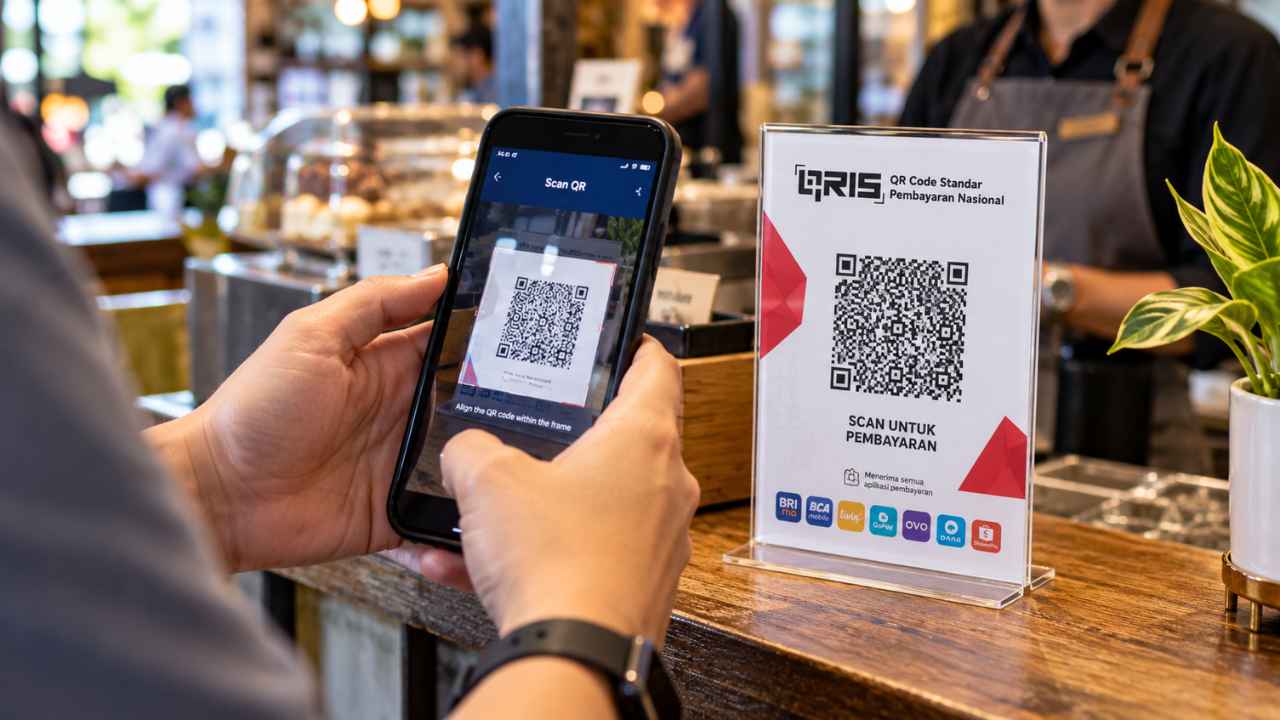
Recommended practice: carry three layers of payment—a card (debit/credit), a reasonable amount of local cash, and a digital payment method. For several ASEAN countries, QRIS can now be used at participating merchants (for example Thailand, Malaysia, and Singapore), although its reach is not as wide as in Indonesia.
5. Travel Documents
Documents are the part of travel essentials that must never be overlooked. Check them well before your departure date, because some documents take weeks to process.
| Document | What to Check | Notes |
|---|---|---|
| Passport | Validity, blank pages, physical condition | Many countries require a validity of at least 6 months on arrival and 2 blank pages; a damaged or peeling passport can be refused. |
| Visa / entry permit | Visa type, validity, number of entries | Some visas can be applied for online (e-visa), others must go through an embassy. |
| Tickets & boarding pass | Name matching the passport, schedule, terminal | Keep the digital version and a screenshot so it opens without internet. |
| Proof of accommodation | Full address, dates matching the ticket | Several countries ask for proof of accommodation during immigration checks. |
| Travel insurance | Medical cover, evacuation, delays | Make sure it is valid at the destination and covers the activities you plan. |
| International driving permit | Issued for the destination country | Required if you plan to drive yourself; get it from an official institution. |
| Health documents | Vaccination certificates, prescriptions for routine medicine | Some countries require certain vaccination certificates from arrivals. |
| Proof of funds / onward ticket | Bank account, onward or return ticket | Some countries check this to make sure you do not intend to stay. |
Safe practices:
- Digital copies of every document on your phone and in cloud storage, plus printed copies of your passport and visa in a bag separate from the originals.
- A spare passport photo and a note of your passport number, visa, and emergency contacts; this speeds things up if a document is lost.
- Note your country’s embassy or consulate at the destination, along with its address and contact number.
- Check the latest entry requirements on the destination’s official immigration or embassy website, because rules can change after this article was written. For ASEAN destinations, check the visa-free list for your passport before booking.
6. Baggage, Power Banks, and Liquids
Baggage rules differ from airline to airline, and low-cost carriers are usually the strictest.
- Cabin baggage is usually limited to around 7–10 kg with a maximum size of about 55 × 40 × 20 cm, though some airlines use smaller limits. Measure and weigh your bag before you leave.
- Checked baggage is usually 20–30 kg on full-service airlines, while low-cost carriers often give only 7 kg of cabin allowance and sell baggage separately. Buying extra baggage in advance is far cheaper than at the airport.
- Power banks and spare lithium batteries must go in the cabin, not in checked baggage. A common benchmark: up to 100 Wh can be carried freely, 100–160 Wh needs airline approval (usually a maximum of two units), and above 160 Wh is prohibited. As a guide, a 20,000 mAh power bank at 3.7 V is about 74 Wh.
- Some airlines ban the use of power banks during the flight and require them to be stored in a specific place. Rules can change and differ by airline and aviation authority, so check your airline’s policy before you leave.
- Liquids in cabin baggage are generally limited to 100 ml per container and must go in a clear plastic bag of a certain size. This also applies to toothpaste, lotion, and semi-liquid products.
- Medicine should be carried in the cabin with a prescription or doctor’s note, especially routine medicine and anything requiring special storage.
- Prohibited items include sharp objects, flammable substances, and certain heating devices. If in doubt, find the official list from your airline or the aviation authority of the departure country.
7. Gear That Is Often Overlooked
A few small items often only feel important once you are at your destination:
- A travel adapter and a small power strip, especially if you carry several devices.
- A power bank and a spare cable. A spare cable is rarely thought about, yet it often fails mid-trip.
- A mini first-aid kit and personal medicine: antacids, painkillers, allergy medicine, plasters, and hand sanitiser.
- A tumbler or collapsible bottle. Many airports and hotels provide free drinking water.
- A TSA-type luggage lock and a handheld luggage scale so you don’t pay for excess weight at the airport.
- A foldable bag as a backup if your shopping grows.
- A rain jacket or folding umbrella, especially for travel in the rainy season.
- A pen and printed copies of documents for filling in arrival or customs declaration forms.
- Layered clothing and a scarf for the chilly air conditioning on planes and public transport.
Quick Checklist Before You Leave
| Timing | What to Do |
|---|---|
| 4–8 weeks before | Check passport validity (at least 6 months), start any visa application, book tickets and accommodation, buy travel insurance |
| 2 weeks before | Check the plug type and voltage of the destination, prepare a travel adapter, buy an eSIM/SIM card, confirm baggage rules |
| 3–7 days before | Tell your bank about overseas card use, download offline maps, copy documents to your phone, exchange a reasonable amount of cash |
| The day before | Check in online, make sure the power bank is in the cabin, weigh your bag, prepare layered clothing for the flight |
| Departure day | Keep your passport in your cabin bag, save screenshots of tickets and boarding passes, wear comfortable clothes, arrive early at the airport |
Common Mistakes to Avoid
- Assuming all plugs are the same. Check the socket type of the destination; an adapter takes up only a little space in the bag.
- Buying an adapter without checking quality. A loose adapter can make charging intermittent.
- Putting a power bank in checked baggage. Besides breaking the rules, it risks confiscation.
- Relying on a single payment method. Prepare a card, cash, and a digital payment method at the same time.
- Forgetting to check passport validity. Six months feels like a long time until you are standing at the check-in desk.
- Not sorting out internet access early. Without data, maps, ride-hailing, and digital payments are hard to use.
- Buying insurance after something goes wrong. Travel insurance must be bought before departure.
- Ignoring the baggage rules of low-cost airlines. Excess baggage at the airport is far more expensive than buying an add-on in advance.
Frequently Asked Questions (FAQ)
What counts as travel essentials?
The most common items in this category are plugs and travel adapters, voltage compatibility, internet access with a SIM or eSIM card, currency and payment methods, travel documents (passport, visa, insurance), and baggage and gear. All of them are preparation tasks, so they are best sorted out before departure.
Can Indonesian devices be plugged in abroad without an adapter?
It depends on the destination. Indonesian plugs are generally Type C (two round pins), which fit directly into the Type C, E, and F sockets widely used in Europe and Vietnam. For countries using A/B (Japan, the United States, Taiwan), G (United Kingdom, Singapore, Malaysia, Hong Kong), or I (Australia, New Zealand) sockets, you need a travel adapter.
What is the difference between a travel adapter and a voltage converter?
A travel adapter only changes the pin shape so the charger fits the socket—it does not change the voltage. A voltage converter steps the voltage down or adjusts it, for example from 220 V to 110 V. If your device states 100–240 V, you only need an adapter. If it only accepts 220–240 V while the destination uses 110 V, you need a converter with sufficient wattage.
Can a power bank be carried in cabin baggage?
Yes, a power bank must be carried in cabin baggage, not checked baggage. Capacities up to 100 Wh are generally allowed, 100–160 Wh requires airline approval, and anything above 160 Wh is prohibited. Some airlines also ban the use of power banks during the flight, so check your airline’s rules before you leave.
How much passport validity do I need to travel abroad?
Most countries require a validity of at least 6 months on arrival, some even longer, and usually 2 blank pages. So check your passport well before booking tickets—the renewal process can take several weeks.
Which is cheaper: an eSIM, a local SIM card, or roaming?
For trips of 3–14 days, an eSIM is usually the most convenient because you can set it up before you leave without hunting for a shop at the destination. A local SIM card is the cheapest per GB for longer trips or heavy data use, though it needs registration and purchase time. Roaming with your home operator is the most convenient for the first few days or as a backup, since your number stays the same, but it is the most expensive.
Do I still need to carry cash?
Yes, as a backup. Many countries are comfortable with cards and QR payments, but cash is still needed for traditional markets, small public transport, paid toilets, and situations when payment machines fail. Carry a reasonable amount in small denominations of the local currency.
Is travel insurance compulsory?
It is not always an entry requirement, but it is strongly recommended and some countries even ask for it when you apply for a visa. Choose cover that includes medical costs abroad, evacuation, travel delays, and lost baggage. Make sure the activities you plan (for example diving or hiking) are also covered.
Do I need an international driving permit to drive abroad?
If you plan to drive yourself, usually yes—an Indonesian driving licence needs to be accompanied by an international driving permit issued by an official body, and some countries also require translation or additional registration. Renting a vehicle without the right documents can lead to legal problems and rejected insurance claims.
When is the best time to start preparing my travel gear?
Ideally, start two weeks before departure: buy an adapter and a data plan, confirm baggage rules, prepare personal medicine, and download offline maps. Jobs involving documents, such as passport renewal or a visa application, need to start one to two months earlier.
Start Here
This page will keep growing with more detailed Travel Essentials guides, topic by topic:
- QRIS for Foreigners: How Tourists Can Pay with QR Codes in Indonesia — how visitors from abroad can pay with QR codes in Indonesia, and when a foreign e-wallet will (or will not) work.
- Plug types and voltage by country — a quick reference table for popular destinations.
- eSIM, local SIM, or roaming — cost comparison and how to activate before you land.
- Managing money and payments abroad — cards, cash, cross-border QRIS, and transaction fees.
- Travel documents: passport, visa, and insurance — the order of processing and what is often missed.
- Packing list and baggage rules — cabin limits, power banks, liquids, and medicine.
- Transport from the airport to the city centre — choosing a train, bus, or taxi at your first destination.
Travelling is not only about choosing a destination and buying a ticket. Small things such as bringing the right adapter, making sure you have internet access, preparing a payment method, and understanding baggage rules can make a big difference during a trip. Get everything ready before you leave, and save your energy for enjoying the journey.
Editorial note: This page is a parent guide written as a preparation framework, not an official rulebook. Plug and voltage standards refer to publications from the International Electrotechnical Commission (IEC) and World Plugs, while baggage and lithium battery rules refer to general IATA rules and each airline’s own policy. Visa, immigration, and travel document rules can change at any time, so the details as of September 2026 should be verified again through the official channels of your airline, aviation authority, and the destination country’s representatives before you set off.