Welcome to Hanoi, the capital of Vietnam and one of the oldest and most characterful cities in Southeast Asia. This is where you find the most classic face of Vietnam: the narrow alleys of the Old Quarter, buzzing since early morning; the calm Hoan Kiem Lake in the middle of the city; pagodas thick with incense smoke; faded yellow colonial buildings; and the smell of pho and egg coffee rising from street-side stalls.
This page is the parent hub for every route guide, area review, food recommendation and travel tip for Hanoi: from visa and currency information and transport from Noi Bai Airport, to the best time to visit, day trips to Halong Bay and Ninh Binh, and the local etiquette you should understand before you set off.
Quick Facts and Important Information
| Category | Details |
|---|---|
| Status | Capital of Vietnam, the country’s political, historical and cultural centre |
| Region | Red River Delta, northern Vietnam |
| Language | Vietnamese (English is fairly common in hotels, cafés and tour agencies) |
| Currency | Vietnamese dong (VND / ₫) — the value is low, so many prices are written in thousands |
| Time zone | ICT (UTC+7) — the same as WIB, so there is no jet lag from Indonesia |
| Climate | Humid subtropical with four seasons; December – February is cold and misty |
| Airport | Noi Bai International Airport (HAN), about 35 km from the city centre |
Getting to Know Hanoi: The Old Quarter on the Red River
Hanoi has been a seat of power for more than a thousand years. It was once called Thang Long (“Ascending Dragon”) when it served as the imperial capital in the 11th century, and took the name Hanoi in 1831. The legacy of its glory days is still visible today, above all in the Imperial Citadel of Thang Long, a UNESCO World Heritage Site.
Most visitors spend their time in the north and centre of the city, since nearly all the main attractions lie within just a few kilometres of one another and can be reached on foot or with a short ride.
Areas and Districts Worth Knowing
- Old Quarter (Hoan Kiem) — The tourist heart of Hanoi. It holds the 36 craft streets, whose names follow the goods once sold there (Silk Street, Silver Street, Paper Street), narrow tunnel houses, street-side cafés and tour agencies. Everything can be explored on foot.
- French Quarter — To the southeast of Hoan Kiem Lake. Full of colonial buildings, the Hanoi Opera House, classic hotels and government offices. The atmosphere is more open and calmer than the Old Quarter.
- Ba Dinh — A historic area west of the Old Quarter, home to the Ho Chi Minh Mausoleum, the One Pillar Pagoda, the Presidential Palace and the Temple of Literature. Ideal for half a day of historical sightseeing.
- Tay Ho (West Lake) — The most relaxed and modern area, home to many expatriates. There is Tran Quoc Pagoda on the lakeshore, international restaurants, waterfront cafés and shopping centres such as Lotte Mall West Lake.
- Hai Ba Trung & Long Bien — More “authentic” local areas with traditional markets, cheap eateries and the colonial-era Long Bien Bridge spanning the Red River.
- Central & Southern areas (Thanh Xuan, Cau Giay, Ha Dong) — Home to large malls and modern cafés. Useful if you want to see a more contemporary side of Hanoi or find cheaper accommodation.
Main Attractions
Historical and Cultural Sights
- Hoan Kiem Lake & Ngoc Son Temple — A small lake in the middle of the city with the Turtle Tower on its central islet. Crossing to Ngoc Son Temple over the red The Huc Bridge is a must on a first visit to Hanoi. In the morning the lake is busy with locals exercising, and at weekends some of the surrounding streets are closed to pedestrians.
- Temple of Literature (Van Mieu) — Vietnam’s oldest university (1070), dedicated to Confucius. Rows of stone stelae on the backs of turtles record the names of scholars who passed the royal examinations.
- Ho Chi Minh Mausoleum — A grand building on Ba Dinh Square where the body of Ho Chi Minh lies in state. Check the opening schedule, as it is usually closed on Mondays and Fridays and closes for a few weeks each year for maintenance. Dress respectfully and keep quiet inside.
- One Pillar Pagoda & Presidential Palace — Located in the same complex as the mausoleum; the small lotus-shaped pagoda on a single wooden pillar is one of Vietnam’s architectural icons.
- Imperial Citadel of Thang Long — A UNESCO World Heritage Site preserving the layered remains of the imperial palace from the 11th to the 19th century.
- St. Joseph’s Cathedral — A neo-Gothic church built during the French colonial period and now a favourite photo backdrop in the Old Quarter.
- Vietnam Museum of Ethnology — The best museum in Hanoi for understanding Vietnam’s 54 ethnic groups; the grounds hold many full-size traditional houses.
- Water Puppet Theater — A performance of water puppetry typical of the Red River Delta at the Thang Long Water Puppet Theater. It lasts about an hour, with narration in English and French.
- Hoa Lo Prison (Hanoi Hilton) — A museum in a former French colonial prison that tells the dark story of the war years.
- Long Bien Bridge — A historic steel bridge by a French architect; walking along its pedestrian side at sunset offers views of the Red River and the banana gardens below.
Popular Areas and Activities
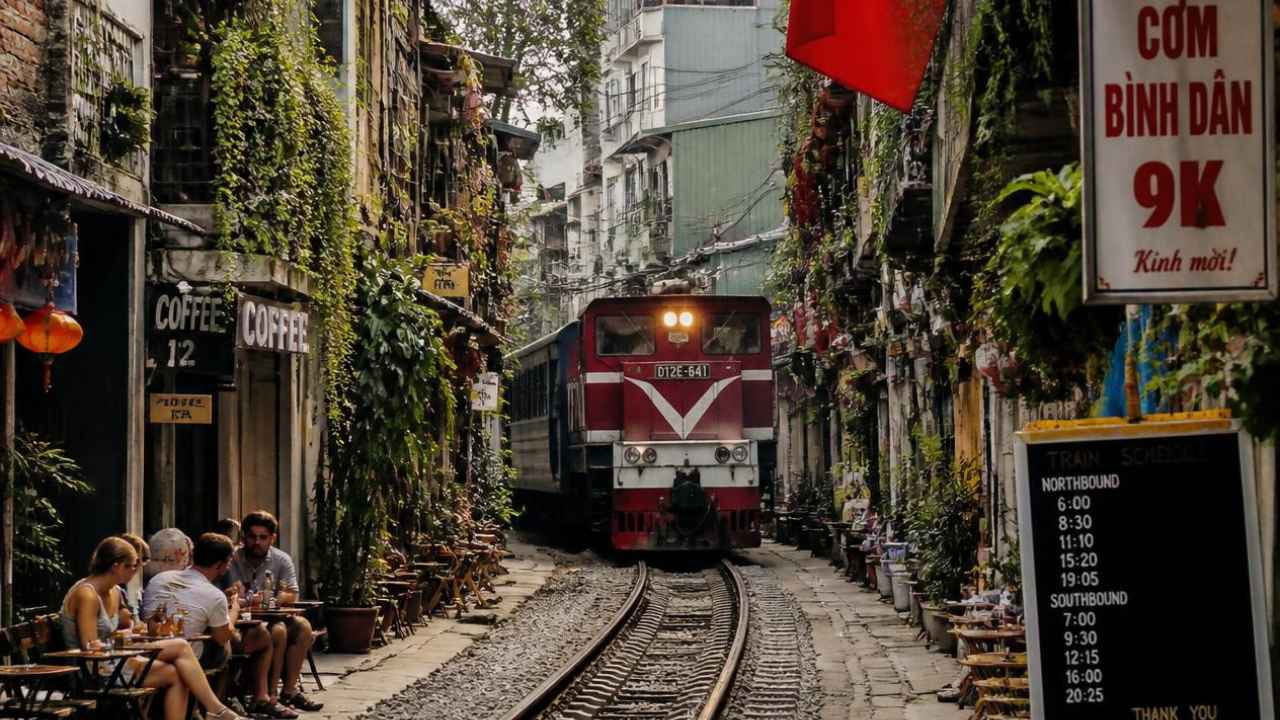
- Train Street — A narrow alley where the train passes just centimetres from people’s homes. You must follow the local rules and enter only through licensed cafés, as safety is often tightened.
- Tay Ho & Tran Quoc Pagoda — Hanoi’s oldest pagoda, standing on a small island in West Lake. Follow it with a relaxed walk or bike ride around the lake.
- Dong Xuan Market — The largest market in the Old Quarter; the ground floor holds food and household goods, while the upper floors sell textiles and souvenirs.
- Cooking Class & Food Tour — A popular way to understand Hanoi’s food culture. Many agencies offer evening street-food walking tours and cooking classes that begin with a market visit.
- Outlying Craft Villages — Bat Trang (ceramics), Van Phuc (silk) and Quang Ba (flowers) can be visited on a half-day trip from the centre.
- Shows & Arts — Besides water puppetry, there are ca tru and quan ho performances at several small theatres in the Old Quarter.
| Plug type | Type A, C & F (220 V, 50 Hz) — an adapter may be needed for type G plugs | | City transport | Grab, Be, Xanh SM, Mai Linh taxis, city buses and motorbike rental | | Visa | Short-stay visa-free entry for Indonesian citizens (generally 30 days as an ASEAN country); for longer stays use the official e-visa — requirements can change, so check Vietnam’s immigration website before you travel |
Must-Try Food
Hanoi is the place to sample northern Vietnamese cooking, which tends to be clean, light and reliant on broths and fresh herbs — unlike the sweeter food of southern Vietnam.
- Pho — The most famous icon. In Hanoi the broth is clear and fragrant and not too sweet; choose pho bo (beef) or pho ga (chicken). Many legendary stalls open only in the morning and evening.
- Bun Cha — Charcoal-grilled pork served with a sweet-and-sour broth, rice noodles and fresh herbs. It became even more famous after being visited during a food event with a former US President.
- Cha Ca La Vong — Turmeric fish grilled right at the table in hot oil, eaten with dill, peanuts and rice noodles. One of the most distinctive Hanoi dishes.
- Banh Mi — A French-heritage baguette filled with meat, pâté and pickled vegetables. Handy for breakfast or a packed lunch.
- Banh Cuon — Thin steamed rice sheets filled with pork and mushrooms, served with fried shallots and nuoc cham sauce.
- Bun Rieu & Bun Oc — Noodle soups with field crab or snails; a local breakfast favourite.
- Egg Coffee (Ca Phe Trung) — Thick coffee under a sweet, soft egg cream, invented in Hanoi in 1946. Also try ca phe sua da (iced milk coffee) and coconut coffee.
- Bia Hoi — Very cheap fresh homemade beer sold at street-corner stalls from the afternoon onward; part of the social culture of the Old Quarter.
- Che — A sweet dessert of beans, jelly and fruit, perfect for resting during the afternoon.
Eating tips for Hanoi: choose busy stalls with fast turnover, use small-denomination cash, and don’t hesitate to sit on a little plastic stool on the pavement — that atmosphere is what makes a Hanoi food experience authentic.
Transport and Ways to Get Around
- From Noi Bai Airport (HAN) — About 35 km from the city centre, with a journey time of 30–45 minutes. The easiest options are Grab or an official metered taxi (Mai Linh, Vinasun, Noi Bai Taxi), the cheap airport bus 86, or a hotel pickup. Avoid unmetered taxi offers at the exit.
- Ride-Hailing — Grab, Be and the electric taxi service Xanh SM operate widely and their fares are transparent. Both cash and card/QR payment are available.
- Conventional Taxis — Choose Mai Linh or Vinasun, make sure the meter is running, and keep the receipt if needed.
- Walking — The best way to explore the Old Quarter, the French Quarter and the area around Hoan Kiem Lake, since everything is close. Bring comfortable footwear.
- Motorbikes & Motorbike Taxis — Renting a motorbike is a popular way to get around, but Hanoi’s traffic is very dense; an international driving permit, a helmet and clear insurance are essential. A safer alternative is a ride-hailing motorbike taxi.
- City Buses & MRT — Hanoi’s bus network reaches almost the whole city at very low fares. The Hanoi MRT (the Cat Linh–Ha Dong and Nhon–Hanoi lines) keeps expanding and is a traffic-free alternative.
- Cyclo & Tour Buses — A cyclo (pedicab) is good for a relaxed tour of the Old Quarter; agree on the fare first. Hop-on hop-off buses link the main attractions.
- Crossing the Road — Motorbike traffic is very dense. Walk at a steady pace and constant speed, never stop suddenly, and let the vehicles adjust around you.
Day Trips from Hanoi
Hanoi is the ideal base for exploring northern Vietnam, because many iconic destinations are only a few hours away.
- Halong Bay & Lan Ha Bay — A junk boat cruise among UNESCO-listed karst islands. It can be a long day trip or an overnight stay on the boat. Cruises can be cancelled in bad weather.
- Ninh Binh (Tam Coc, Trang An, Hang Mua) — Nicknamed “Halong Bay on land”: sampan boats glide past karst and rice fields, plus a staircase up to the summit of Hang Mua. About two hours from Hanoi.
- Sapa & Fansipan — Rice terraces, Hmong and Dao ethnic villages, and the highest peak in Indochina. Usually reached via a night train to Lao Cai or a limousine bus.
- Ha Giang — A motorbike loop route with the most dramatic canyons and mountain roads in northern Vietnam; it needs a minimum of two to three days.
- Cat Ba Island — The largest island in Halong Bay, with a national park and forest trekking.
- Mai Chau & Tam Dao — Closer mountain alternatives for village scenery and cool air.
- Bat Trang & Co Loa — A half-day option if time is very limited.
Best Time to Visit
Hanoi has four distinct seasons, so your experience will depend heavily on the month you visit. In general, October – April is the most comfortable period, with a few notes:
- March – April (Spring) — Warm temperatures, flowers blooming and little rain. One of the best times for walking around the city.
- October – November (Autumn) — Clear skies and cool, dry air. Many travellers consider it the best month of the year.
- December – February (Winter) — Cold and misty; temperatures can drop to around 10 °C in Hanoi and near freezing in Sapa. Bring a thick jacket, especially for trips to the mountains.
- May – September (Summer & Rainy Season) — Hot, humid and often subject to heavy rain. July – September is also storm season, so Halong cruises risk being cancelled. Accommodation prices are usually lower.
- Festivals to Plan Around — Tet (Lunar New Year, January/February) is the biggest celebration: many shops and offices close, ticket and hotel prices rise, and intercity transport fills up. There is also the Mid-Autumn Festival (September) and National Day (2 September), usually accompanied by fireworks around Hoan Kiem Lake.
Tips and Travel Etiquette
- Respect places of worship. Wear clothing that covers your shoulders and knees at pagodas and temples, take off your shoes before entering inner rooms, and do not touch statues or altars.
- Dress respectfully at the Ho Chi Minh Mausoleum and keep quiet — staff will caution visitors who dress too revealingly or speak loudly.
- Give and receive with both hands, or at least with your right hand, to show respect; this applies when handing over money, business cards or gifts.
- Do not touch other people’s heads, and avoid pointing your feet at people or statues while sitting.
- Ask before photographing people, especially ethnic minority communities in Sapa and Ha Giang. Avoid photographing military installations or border posts.
- Bargain politely in traditional markets such as Dong Xuan, but prices in malls, convenience stores and shops with price labels are usually fixed.
- Cash still matters. The dong has a low value, so you will be carrying a lot of notes; keep small denominations for food stalls, cyclos and public toilets. Cards and QR payments are increasingly common in the big cities.
- Watch out for common scams: unmetered taxis from the airport, tours or motorbike rentals offered too cheaply, “tourist-only” prices in cafés with no price list, and overcharging in tourist areas. Book transport through an app if you are unsure.
- Connectivity: buy a local SIM (Viettel, Mobifone, Vinaphone) or an eSIM at the airport, and download the Vietnamese language pack for Google Translate offline.
- Water & food: drink bottled water, choose busy stalls for fresh food, and wash your hands or carry hand sanitiser.
- A few useful phrases: xin chào (hello), cảm ơn (thank you), bao nhiêu? (how much?) and không, cảm ơn (no, thank you) to decline an offer politely.
- Winter & rain: bring layers, a folding umbrella and non-slip footwear, as the pavements can be slippery.
Hanoi is a city best enjoyed slowly. Start with a leisurely walk around Hoan Kiem Lake in the morning, carry on through the alleys of the Old Quarter, and end the day with a bowl of pho and a glass of egg coffee at a street-side stall. From here, every trip into northern Vietnam — Halong Bay, Ninh Binh, even Sapa — feels easy to plan.
In-depth guides to Hanoi’s areas, transport routes and food will be added to this page as more articles appear, so bookmark it as the starting point for your trip.