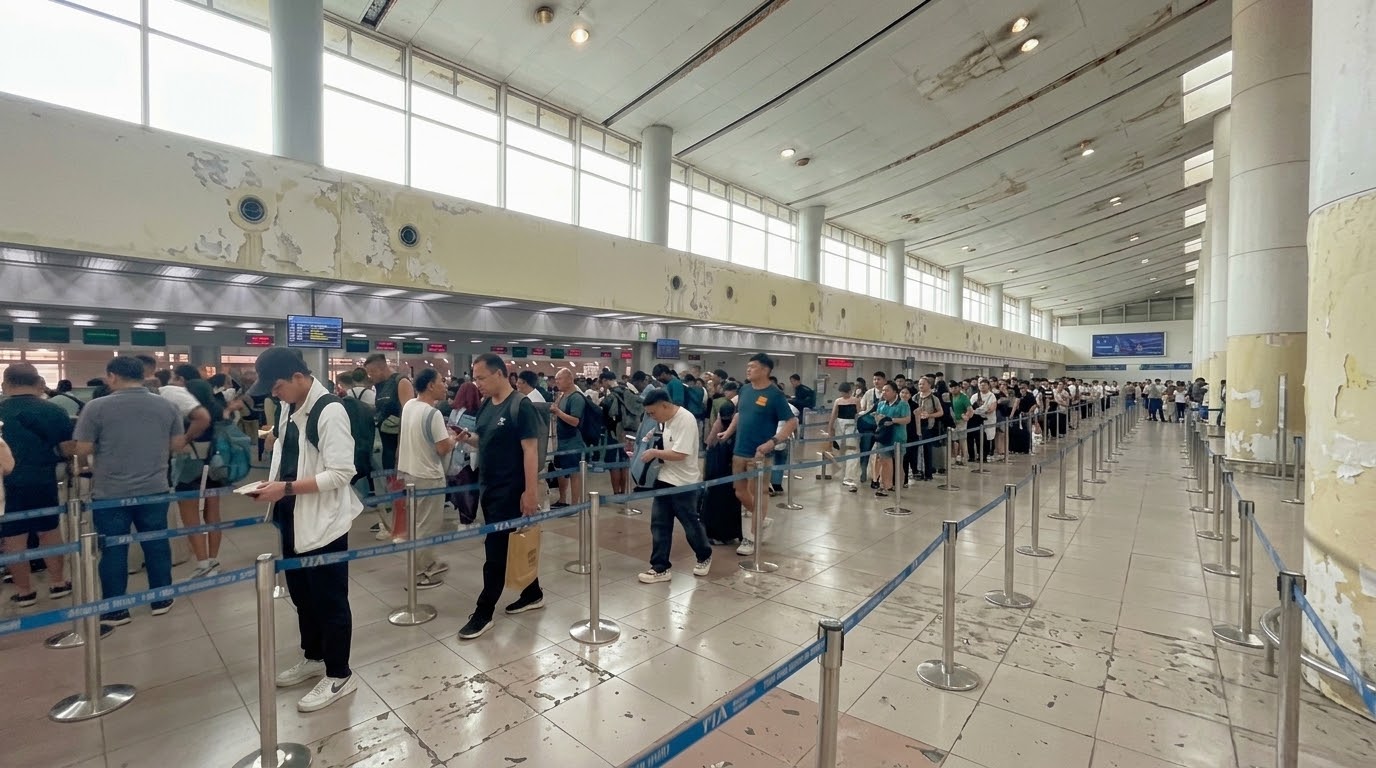
As soon as you land at Noi Bai International Airport (HAN), Terminal 2 Hanoi, the first test of the trip is usually not your luggage and not customs either—it is the arrivals immigration hall. Stepping off the jet bridge toward the passport counters, the sight that greets you is often a long, snaking sea of people, especially during the peak hours for international arrivals.
The good news: holders of an Indonesian passport do not need a visitor visa for a stay of up to 30 days in Vietnam. The part you need to prepare for: visa-free does not mean a fast lane. At Noi Bai Terminal 2 there is no dedicated ASEAN lane, so you still join the same line as every foreign passport holder—from Western tourists and East Asian travellers on e-visas to large tour groups.
This article sums up the reality of the Noi Bai immigration queue: why the line can get so long, how long a realistic wait is, which documents you should already be holding, and practical tactics so the first hour of your holiday isn’t spent just waiting for your turn at the passport stamp.
Quick Summary: Immigration at Noi Bai Terminal 2
| Category | Details |
|---|---|
| International arrivals terminal | Noi Bai Terminal 2 (HAN) |
| Categories on the monitor boards | Only two: Vietnamese Passports and Foreign Passports / All Passports |
| Dedicated ASEAN lane | None — every non-Vietnamese passport joins the same queue |
| Visa-free for Indonesian passports | Stays of up to 30 days without a visa (ASEAN visa-free agreement) |
| Wait time when quiet | Around 20–30 minutes |
| Wait time at peak hours | Can be 1–1.5 hours just to reach the passport stamp counter |
| Main triggers of the queue | 2–3 wide-body aircraft landing close together, plus e-visa/visa on arrival verification at the counter |
| Documents to have ready in hand | Original passport, boarding pass, proof of onward ticket out of Vietnam, name & address of your accommodation |
| How to speed up | Walk fast from the moment you leave the plane, avoid tour-group lines, don’t wait for your baggage first |
Why the Noi Bai Immigration Queue Can Snake So Long
The arrivals hall at Noi Bai Terminal 2 is fairly large, but the number of immigration counters that open does not always match the number of passengers who disembark at the same time. There are four causes that come up most often.
1. No dedicated ASEAN lane at Terminal 2
Many people assume that an international airport in Southeast Asia automatically provides a dedicated lane marked ASEAN Lane. In reality, at Noi Bai Terminal 2 the monitor boards in the arrivals hall practically show only two categories: a lane for local citizens (Vietnamese Passports) and a lane for all foreign nationals (Foreign Passports / All Passports).
So even though Indonesia is a fellow ASEAN member state, with visa-free entry of up to 30 days for an Indonesian passport, don’t picture a red-carpet lane here.
2. All foreign nationals are merged into one big line
Every non-Vietnamese passport holder—Western tourists, East Asian travellers holding a visa or e-visa, tour groups, and fellow ASEAN citizens—joins the same line. That single long queue serves almost every need at once, so its pace is set by the slowest passenger ahead of you.
3. E-visa and visa on arrival verification slows the pace
Passengers without visa-free entry who need extra document verification often take longer at the counter—from matching the e-visa to the passport to checking supporting documents. The effect ripples: one person needing lengthy verification automatically slows the queue behind them, including you who really only needs a single stamp.
4. Wide-body aircraft arrive close together
When 2–3 wide-body aircraft land within a short window of each other, the number of passengers entering the immigration hall spikes within minutes. If the number of counters opened doesn’t increase accordingly, a line that was moving quickly can turn into a queue that has almost stopped.
How Long Is the Queue? Here Are Realistic Benchmarks
The queue duration at Noi Bai Terminal 2 depends heavily on when your flight arrives. The following benchmarks are useful for working backwards to schedule a pickup, a transfer, or a dinner reservation on day one.
| Arrival conditions | Estimated wait time | Notes |
|---|---|---|
| Quiet (outside peak hours) | 20–30 minutes | Usually only one international flight disembarking; the line is still sparse |
| Moderate | 30–60 minutes | Two aircraft land close together, but the counters still keep up |
| Peak hours (afternoon–evening or night) | 1–1.5 hours | 2–3 wide-body aircraft land close together; the line crawls |
The times above are only for reaching the passport stamp counter. Add time for collecting your baggage at the baggage carousel and for the customs check before you are actually in the pick-up area.
In practice: if you land in the afternoon–evening or at night, treat the first hour after leaving the plane as “immigration time” that cannot be spent on anything else. Don’t arrange to meet a driver or a friend at a specific time without leaving a buffer.
Tactics for the “All Foreigners” Queue
Because all foreign nationals are funnelled into the same lane, positioning and document readiness become the main deciding factors. Here is the order of the things that make the most difference.
- Walk fast from the aircraft door. Don’t stop at the toilet in the arrivals corridor unless it’s a real emergency. Every 2–3 minutes of strolling can put you behind another 50–100 people.
- Avoid standing behind a tour group. When choosing a counter line, look at who is ahead of you. Avoid a queue containing a tour guide holding a stack of passports or a large family with layers of documents.
- Pick the outermost line that’s still open. If several counters are active for the foreign lane, the edge line often moves first compared with the middle line that was already packed from the start.
- Have your documents in hand before you reach the booth. Don’t start opening your bag or removing the plastic passport cover only when you’re face to face with the officer.
- Don’t wait for your baggage first. Immigration is the first stage after leaving the plane; your baggage waits on the conveyor and is actually found faster if you clear immigration first.
- Split the tasks if you’re travelling in a group. One person can walk at the front to secure a spot, while the others catch up carrying the documents for all family members.
- Cut down on phone time while the line moves. A fast-moving queue easily lets passengers behind you overtake without you noticing.
Documents to Have Ready in Hand
Most delays at the counter happen because documents aren’t ready, not because the officer is slow. Get everything ready before you leave the plane.
- Original passport. Remove the protective plastic cover before you reach the officer’s booth.
- Boarding pass. Keep the boarding pass for the flight you just took; officers often check the arrival flight number.
- Return or onward ticket out of Vietnam. Have proof of onward travel out of Vietnam in an offline format on your phone or a printout, to prove your stay doesn’t exceed the 30-day visa-free allowance if you’re asked.
- Name and address of your accommodation. Know exactly where you’re staying (for example in the Old Quarter/Hoan Kiem area), not just the name of the booking app.
- Phone battery and connection. Make sure your phone battery is sufficient. Wi-Fi in an airport immigration area is often congested and slow because hundreds of people use it at once, so save important documents as screenshots or offline files.
- E-visa file (if you’re using one). Passengers arriving on an e-visa should print or save a digital copy to speed up verification at the counter.
30-Day Visa-Free: What You Need to Prove
Visa-free entry saves cost and the hassle of applying in advance, but it isn’t unconditional. What generally applies to Indonesian passport holders:
- A maximum stay of 30 days for tourist visits, and it must not be used to work.
- A passport with sufficient validity (generally at least six months from the date of arrival).
- Proof of an onward ticket out of Vietnam may be requested to confirm you won’t exceed the 30-day limit.
- If you want to stay longer than the visa-free allowance, arrange a visa or e-visa before you depart—not at the arrivals counter.
Immigration rules can change at any time. Before you travel, recheck the latest requirements on Vietnam’s official tourism information portal, vietnam.travel, and Vietnam’s official e-visa portal, evisa.xuatnhapcanh.gov.vn.
After You Clear Passport Control
Once your passport is stamped, the trip usually becomes much smoother:
- Baggage is already waiting. Because the queue was long, suitcases on the baggage carousel have usually stopped rotating or have even been neatly set aside by staff next to the conveyor belt.
- Clear customs. Prepare a declaration if you’re carrying goods that must be reported, then follow the exit route.
- Head to the official pick-up area. Choose transport to suit your needs: Express Bus 86 for those going straight to the Old Quarter at a fixed fare, an official taxi, or an app-based service.
- Buy a local SIM card or exchange cash. Airport exchange rates are usually less favourable than in the city; change just enough for transport and your first meal.
For getting from the airport to the city centre, we’ve covered it step by step in the article Bus 86 from Noi Bai Airport to Hanoi Old Quarter—including how to find the stop at Terminal 2, the fixed fare of around 45,000 VND, and the nearest drop-off point to the Old Quarter.
Pre-Landing Checklist (Before You Leave the Plane)
- ☐ Passport in hand, plastic cover removed.
- ☐ Boarding pass stored in your cabin bag, not in checked baggage.
- ☐ Proof of an onward ticket out of Vietnam already offline (screenshot or printout).
- ☐ Name and address of your accommodation written down.
- ☐ Phone charged and important documents saved offline.
- ☐ Cabin bag organised—no need to open it again when you reach the immigration booth.
- ☐ Ready to get up and walk fast the moment the aircraft door opens.
Frequently Asked Questions
Is there a dedicated ASEAN lane at Noi Bai Airport? No. At Noi Bai Terminal 2, the monitor boards practically show only two categories: the Vietnamese Passports lane for local citizens and the Foreign Passports / All Passports lane for all foreign nationals. ASEAN citizens are in the same line as other foreign passport holders.
If an Indonesian passport is visa-free, do I still have to queue for a long time? Yes. Visa-free removes the obligation to arrange a visa in advance, not the passport stamp process. Because there is no dedicated ASEAN lane, Indonesian citizens still join the “All Foreigners” queue and the time depends on how busy the arrivals are.
How long is the queue at immigration at Noi Bai Terminal 2? When quiet, around 20–30 minutes. At peak hours (midday–afternoon or night) when 2–3 wide-body aircraft land close together, the wait can exceed 1 to 1.5 hours just for the passport stamp.
When are the busiest arrival times? Generally from midday through the night, especially when several long-haul flights arrive close together. If you can choose, flights landing in the morning or outside peak hours tend to be quieter.
What documents should I prepare while queueing? Your original passport without a plastic cover, the boarding pass for your arrival flight, proof of an onward ticket out of Vietnam (offline or printed), and the name and address of your accommodation.
Should I collect my baggage before immigration? No. Immigration comes before the baggage area, so you must clear the passport stamp first. Because the queue can be long, your baggage is usually already available on the conveyor by the time you reach the collection area.
Can I skip the queue with a fast track service? Some third-party services offer paid fast track at Noi Bai Airport. Such services operate commercially and are not run directly by immigration, so availability, price and conditions can differ and change. If you want to use one, make sure you book through a trusted channel and confirm the meeting point at the terminal before you travel.
Closing
The Noi Bai immigration queue is one of the things first-time visitors to Hanoi complain about most, but it can actually be managed. The key is not a special trick but positioning and readiness: walk fast from the moment you leave the plane, don’t stand behind a tour group, and make sure your passport, boarding pass and proof of onward ticket are in hand before you reach the officer’s booth.
With a realistic wait of 20–30 minutes when quiet and up to 1.5 hours at peak times, leave an hour of slack after landing to clear immigration, baggage and customs. After that, we can talk about the pleasant things—egg coffee in the Old Quarter, the alleys of the Old Quarter, or a trip to Halong Bay.
Keep preparing with the Vietnam travel guide for an overview of destinations across the country, the Hanoi travel guide for details of the districts and the food, and the article Bus 86 from Noi Bai Airport to Hanoi Old Quarter for cheap transport from the terminal to your accommodation. If this is your first trip abroad, the notes on etiquette abroad also help you avoid small misunderstandings in your destination country.
Editorial note: the queue durations, lane categories and experiences in this article are summarised from travel material for entering through Noi Bai Airport Terminal 2 (HAN) that we gathered while writing. Wait times can vary with the number of counters opened, aircraft arrival schedules, and changes in immigration policy. Visa-free rules, length of stay and required documents can change—recheck them on the official Vietnam e-visa portal and the official Vietnam tourism site before you travel.